

5 lessons from my conversation with Zaria Parvez
How the Head of Social at DoorDash navigates career growth and burnout
In the social media industry, Zaria Parvez is a household name. She’s the Head of Social at DoorDash, and has earned honors like AdAge Social Marketer of the Year, Adweek Creative 100 and Forbes 30 Under 30. Yet, her most well-known title might still be the Duolingo Owl.

As the mind behind the big green owl, Parvez grew the brand’s TikTok following from 15,000 to 16 million from 2020–2025. With her at the helm, Duolingo became the de facto brand on social media. But then she walked away from Duo to lead social at DoorDash, a brand which became another darling under her leadership.
I had the honor of speaking to Parvez about how high-performing social teams and marketers can protect their energy while proving impact and growing their careers. We talked about the highs and lows of her own career, plus which criticism matters and which…doesn’t.
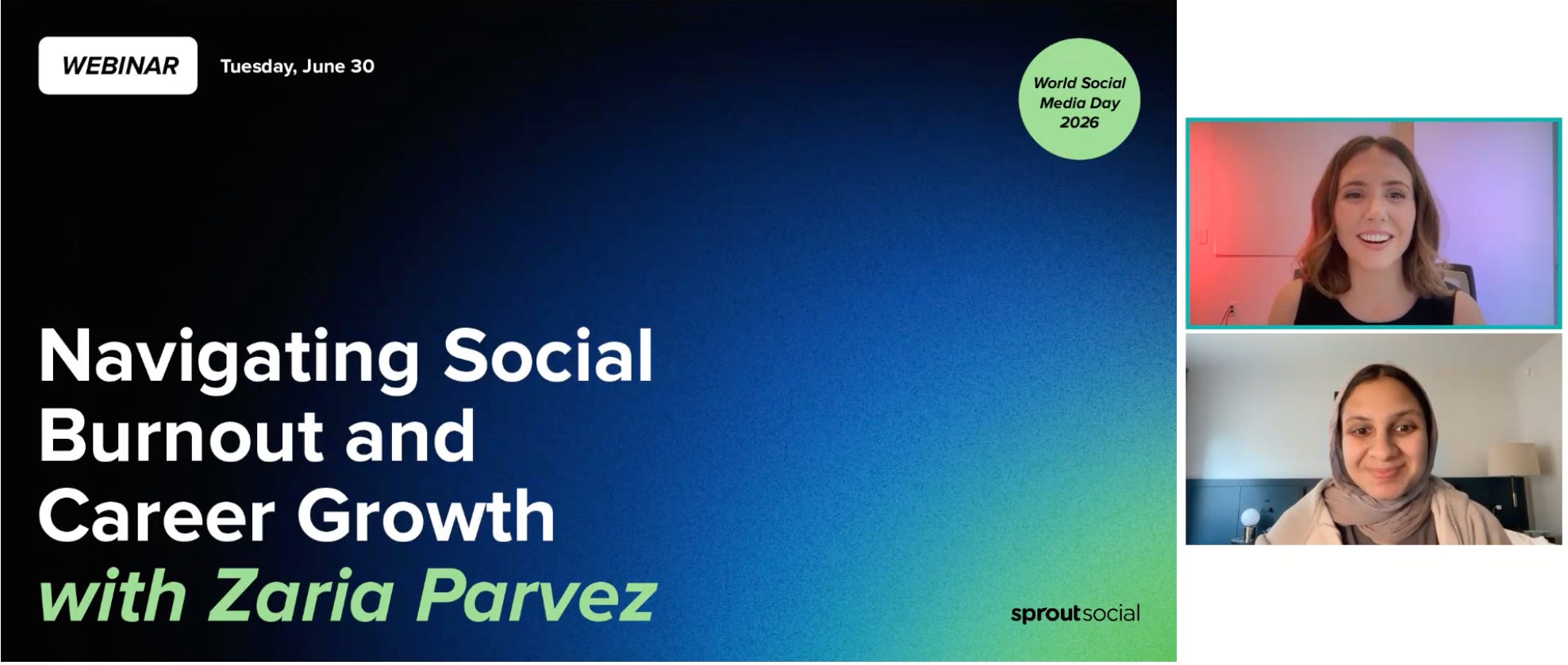
You can watch the entire conversation on-demand. I also wrote down some of my personal reflections, highlighting the moments that expanded how I think about working in this industry and pieces of advice I want to remember.
1. You have to flop to fly
Parvez isn’t afraid of a flop.
As she put it, “No other org is expected to do what going viral is every single day…You can go viral. Everyone loves it for twenty-four hours, and then it’s like, ‘What’s next? What’s next?’ Like damn. I’m sure I’m preaching to the choir here, but the flops teach you much more than the wins a lot of the time. A win can be strategic. A lot of it is also serendipitous. The internet just happened to love that piece of content, and it blew up. But I don’t actually know why it did that well. And sometimes something I thought would do great completely flopped. But it helps give you those insights. ‘This is what people like. This is what they don’t like.’ You gotta flop to fly sometimes.”
It’s really discouraging when posts you’ve spent hours (or days) on—and jumped through multiple approval workflows for—are only liked by a handful of people. We’ve all been there.
It can be even more blindsiding when a post you barely spent any time on becomes the year’s top performer. During a prep call for our interview, Parvez confided that the green owl persona was born accidentally when she commented on a post from the Duolingo account, thinking it was her personal handle. The incident went viral, a happy mishap that changed the course of brand social.
But these aren’t the only two realities. Most content falls somewhere in the middle, earning an average number of views, likes and conversions. Other times, in blissful, kismet moments, the Reel or Carousel that you poured your heart into delivers on engagements, reach and revenue.
The point is that all of us have an entire portfolio of content that’s worked and content that hasn’t worked. Sometimes it’s due to factors out of our control, other times it’s because our idea just didn’t land with our audience (at that time, in that format).
Social-first marketers have their work judged on the world’s stage, perhaps more than any other marketing discipline. It would be easy to tie our value as professionals to the outcome of a single post we really wanted to succeed. But everyone, even leaders like Parvez, has flopped.
Learn what you can from every flop and keep moving forward. Don’t let it define you, and keep giving yourself space to experiment and be creative.
Oh, and use your flops as proofpoints when other teams try to dictate your calendar. Which brings me to my next point…
2. Know who your “daddy” is
Many social teams are beholden to departments across their entire company—or at least, they feel like they should be. They think (or are told) they have to say yes to every request in the spirit of being “good collaborators.”
Parvez recounted the advice she received from her boss at DoorDash that completely reoriented the way she thinks about people-pleasing.
“My boss told me: Always remember who your daddy is. I was like, ‘What?!’ She said, ‘I’m your daddy, and my boss is your daddy. Nobody else at DoorDash is your daddy.’ Now I always say that when someone says, ‘You have to do this. You have to do this.’ And I’m like, ‘You’re not my daddy. You can’t tell me what to do.’”
Having a leader that respects your vision, time and resources, and advocates for your team in meetings you’re not part of makes it a lot easier to create these boundaries.
But that isn’t always the case. When it’s not, it’s up to social teams to hold the line and educate their colleagues about their goals and purpose. Your “daddy” might not be a specific person, it could instead be your team vision (i.e. reshaping brand perception) or audience insights (i.e. data that shows what drives actual impact).
The point is, you aren’t accountable to everyone. You can’t be everything. Remember the goal you’re working toward and what you’re trying to build.
3. Listen to the opinions that matter
It isn’t an exaggeration to say that Parvez has been publicly criticized more than any other individual social marketer. Self-appointed pundits have decried her major brand moves, from adopting an unhinged strategy and killing the owl at Duolingo to working with unexpected public figures at DoorDash.
Though few, if any, of these critics have created social strategies as prolific as she has.
“The creative work you put out there is almost an extension of you, no matter how much you try to deny it. I care about the performance of something I create because I spent time creating it, ideating it and working on it. And sometimes you’ll get people who are really critical of it…It’s important to remember who you want to take feedback from. Is this someone who you really respect in social who makes great creative and is an amazing copywriter? I’m most likely gonna take that feedback. Or is this someone who barely uses social and only has two photos of their dog on Instagram? Probably not gonna take their feedback…Controversial opinions usually just bubble to the top because that’s how the world works,” advised Parvez.
Everyone believes they’re capable of creating social content just because they consume social content. But the truth is that it’s a highly specialized skillset. Much of the critique social marketers receive is from people who have never felt the pressure of the brand handle on their shoulders—especially not one with millions of followers.
And, at the end of the day, when it all feels like too much, lean on your family and friends outside the industry, especially the ones who never understand what you do for a living anyway. In a particularly sweet moment, Parvez shared that the only critics who really matter are her family, who don’t understand the social industry at all.
4. Know when you’ve reached your growth potential
Every role has a ceiling, something Parvez has experienced first-hand. When you reach that limit, it’s your responsibility to find another level and aim for it—whether it’s a new role or an entirely new company.
As Parvez advised, “Getting on the viral treadmill is a really risky and scary place to be. You’re expected to replicate it over and over. There’s never going to be a moment where it’s enough. Your brand is going to ask for more. I always aim for one to three big wins a quarter. That’s enough. And being able to articulate why they worked is more important than the actual posts or campaigns themselves. You can grow the brand account, but there will eventually be a cap. There’s a point where you’re helping the brand more than you’re helping yourself. It’s important to learn to do both. The second you aren’t able to keep growing, then it’s your time to find a new role or organization.”
The potential for what’s possible in the social industry has changed exponentially in the past few years alone.
It’s become more domain-focused than ever, with roles in influencer marketing, community engagement and social intelligence becoming more commonplace. Plus, social leadership roles are moving up the corporate ladder, and directors and VPs of social are now the norm. Parvez predicts we’re on the precipice of having a wave of CMOs who started as social media marketers.
5. Set the temperature in every room
When it comes to Parvez’s working style, one word comes to mind: thermostat.
She recounted the power of setting the emotional tone, “People will say: ‘Why didn’t you go viral?’ ‘Why didn’t the budget we have you immediately convert?’ ‘How do you quantify everybody talking about you?’ It’s really easy to get frustrated, reactive and not want to do this anymore. Being a thermometer is about forming educated responses that declare what the social team is here to do. That’s hard, but it’s such an important skill to learn. Even learning to give that feedback upward to your boss can be really necessary. That skill set is probably one of the most crucial and important things that has gotten me through multiple cancellations, multiple crises, multiple wins and the internet cycle in general.”
As Parvez pointed out, social teams are often put in positions to absorb other people’s emotional states. Whether it’s panic over an overblown “brand risk,” leaders working themselves into a tizzy wondering why more posts aren’t going viral or harsh public feedback that borders on internet bullying, social marketers are (understandably) prone to mirroring these intense emotions if they don’t hone emotional regulation skills.
Of all the wisdom Parvez imparted during our chat, this point resonated most deeply. For social media marketers and leaders—many of whom have struggled to articulate their worth and secure adequate budget, headcount and resources—it’s easy to fall into the trap of thinking our work isn’t good enough. The negative feedback from so many sources can accentuate those feelings.
Becoming a thermostat means having a strong sense of your own self-worth, personally and professionally. It means acting from a state of calm and confidence, trusting yourself and your intuition.
For more from Parvez on how to build a sustainable career in social, check out her Career Framework for Social Media Professionals.
The social dispatch
Before you go, here’s a line-up of the articles, social posts and cultural moments catching our attention from the industry this week.
The heartwarming cultural exchange content from the World Cup that’s all over our feeds might not all be genuine, as reported by The New York Times. But that doesn’t mean it’s all fake.
Creators are filing trademarks for phrases that start with “hot girls who…” and the backlash has been swift, per Moneywise. The incident reignited the conversation about intellectual property surrounding creators and niche communities.
Starbucks is piloting a TikTok program for boosting employee-generated content this summer, according to Marketing Dive. This is an exciting new chapter in the world of employee content. More details to come on how the program works.
We recently partnered with The Wall Street Journal on an article about the rise of the #baldmaxxing movement. The subreddit r/bald has almost half a million followers and 1.2 million weekly visitors. According to data we provided, the number of interactions on the page is already seven times higher than 2024.
 | A guest post by
|